

Light Adjustable Lens
In Beverly Hills, Los Angeles, CA


LAL Experience
Selecting a Lens Implant (IOL) for Cataract or Refractive Lens Exchange Surgery
Dr. Hamilton uses pre-surgery eye measurements and intraoperative diagnostic tools at his office in Beverly Hills, Los Angeles to estimate the power and type of IOL he thinks will provide you with the best vision after surgery.
Every eye of every patient heals in its own, unique way. This healing process can affect the position of the IOL in the eye. If the IOL heals into place more towards the front of the eye than average, the eye ends up slightly nearsighted. Similarly, if the IOL heals into place more towards the back of the eye than average, the eye ends up slightly farsighted.
Despite the number and quality of measurements used to select the IOL power and predict the visual outcome, it is still just an estimate for any given patient. And because every eye heals slightly differently after surgery, getting ‘close’ to the predicted outcome is often the best result a patient can expect. If the visual target is not achieved, this can be corrected by glasses, contact lenses, or additional surgery, such as LASIK or by removing and replacing the IOL.
Light Adjustable Lens
- Customizable Vision Correction
- Uses Proprietary Light Technology
- Adjustable After Surgery
- Addresses Residual Refractive Errors
- Reduces Dependence on Glasses
- Clinically Proven Results
Light Adjustable Lens Patient Experience
The Light Adjustable Lens (LAL) is the only IOL that enables you and Dr. Hamilton to design, trial, and customize your vision after cataract surgery. Adjustability takes cataract surgery to the next level by giving you a lens customized specifically for your eyes.
In an FDA study of 600 subjects, those who received the LAL were twice as likely (as those who received a standard monofocal IOL) to achieve 20/20 vision without glasses.
The Light Adjustable Lens is made of a special photo-sensitive material that changes the power of your implanted lens in response to UV light, increasing the likelihood that you will achieve your desired vision after cataract surgery.
If you select the Light Adjustable Lens, the first step is to have your cataract safely removed and the adjustable IOL implanted. The cataract removal and IOL implantation procedure are the same as if you selected a standard (non-adjustable) IOL.
Now for the unique part! After your eye heals, you return to your eye doctor to have your vision tested during a routine eye exam. Based on this exam, you and your eye doctor will select a custom prescription for your adjustable lens based on your own eyes and unique lifestyle requirements.
Ready to see the world more clearly?
How are Cataracts Treated?
The only treatment for cataracts is to remove the cloudy natural lens and replace it with a clear artificial lens. This lens is called an intraocular lens (IOL). Cataract removal surgery is the most common procedure in the world and is one of the safest and most successful procedures performed today.
Cataract surgery can also offer the opportunity to correct other visual problems you may experience such as myopia (nearsightedness), hyperopia (farsightedness), astigmatism (irregularly shaped lens), or presbyopia (diminishing ability to focus with age.
UV Light Sensitive Lenses after Cataract Surgery
The sun is the primary natural source of UV light, and artificial sources of UV light are safely used in many medical and ophthalmic treatments. However, as exposure to indoor and outdoor sources of UV light can cause uncontrolled changes to the Light Adjustable Lens– you will be provided with UV protective glasses to wear during all waking hours when outdoors (from time of lens implantation until after the last light treatment is completed).
24 hours after the final light treatment, no further changes can be made to the implanted LAL, and you can remove the UV protective glasses and enjoy your custom vision.
Light Treatments
To receive the light treatment, you will be placed in front of the Light Delivery Device, which will non-invasively deliver the UV light to your Light Adjustable Lens.
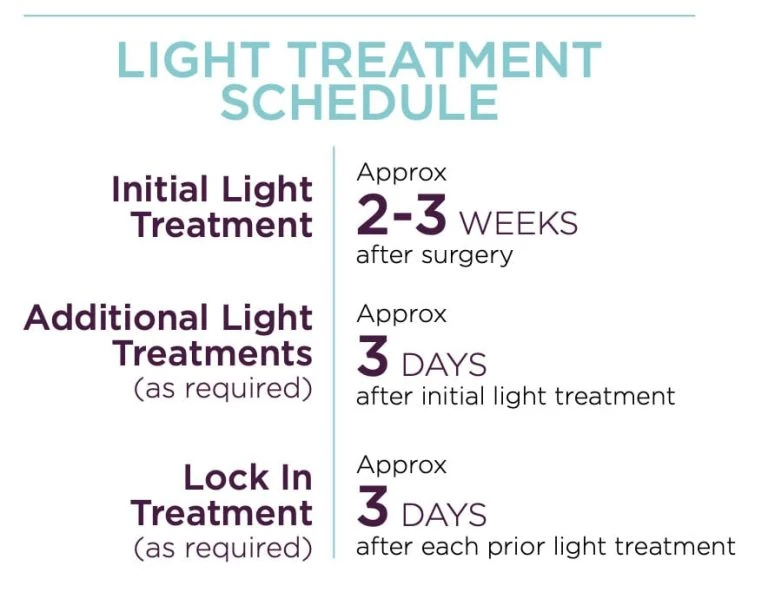
Between 2 and 4 total light treatments, each lasting approximately 90 seconds and separated by approximately 3 days are required. The total number of treatments is based on your satisfaction with the vision achieved. For the first time ever, you can have confidence that your result will be just how you want to see the world.
Light Treatment Schedule
A minimum of 2 light treatments—each lasting approximately 90 seconds and separated by approximately 3 days—are required. The total number of light treatments is based on achievement of the desired vision outcome that you and your doctor selected.
Once you have achieved your final optimal vision, the lens power is permanently locked in with a final light treatment to prevent any further changes.

Who Can Benefit?
The U.S. Food and Drug Administration has approved the Light Adjustable Lens and Light Delivery Device for patients with pre-existing astigmatism of 0.75 diopters or more who are undergoing cataract surgery.
Another type of intraocular lens implant is called a Multifocal IOL. Dr. Hamilton will make a recommendation as to whether the LAL or Multifocal IOL is the best option for your unique situation and will review why he is making the recommendation.
Important Safety Information
Intended Use: The Light Adjustable Lens (LAL) combined with the Light Delivery Device (LDD) is designed for cataract surgery patients who also present with corneal astigmatism of 0.75 diopters or greater prior to the procedure, and who have no history of macular disease.
Who is not a suitable candidate? This treatment may not be appropriate for you if you currently take medications known to heighten UV light sensitivity or that carry risk of retinal toxicity. Additional contraindications include a history of ocular herpes infection, a diagnosis of nystagmus (involuntary eye movement), or an inability to follow the prescribed light treatment schedule and wear UV-protective eyewear consistently throughout the post-operative period.
Important warnings to consider: Certain pre-existing eye conditions — including macular disease — can elevate the risk of surgical complications. Dr. Hamilton will conduct a thorough evaluation to confirm whether the LAL is the right choice for your eyes. In the event that complications arise during the cataract removal procedure itself, a different IOL may need to be used in place of the Light Adjustable Lens.
Key precautions: The LAL and LDD system has not been fully studied in patients with specific pre-existing ocular conditions or in cases where surgical complications occur. It is essential to discuss your full eye health history with Dr. Hamilton. After surgery, UV-protective glasses must be worn during all waking hours for approximately 4 to 5 weeks. Skipping this step — even briefly — can result in unintended changes to the lens due to UV exposure from sunlight or other sources, potentially requiring a second surgical procedure to replace the implant.
Potential risks to be aware of: Like all surgical procedures, cataract surgery and IOL implantation carry inherent risks that Dr. Hamilton will review with you in detail. Risks specific to the LDD light treatment process may include subtle temporary shifts in color perception, and mild surface-level eye discomfort such as dryness, irritation, or scratchiness. In rare cases, UV light exposure during treatment could trigger a previously dormant herpes eye infection. Serious or long-lasting complications are uncommon, but there is a small possibility that vision outcomes could fall short of expectations or that additional surgery may be needed.
Frequently asked questions
A Light Adjustable Lens (LAL) is an innovative intraocular lens (IOL) used in cataract surgery that can be adjusted post-operatively using a special light treatment to fine-tune vision.
The LAL contains a photosensitive material that can be altered with a specific UV light wavelength after surgery. This allows ophthalmologists to make precise adjustments to correct any residual refractive errors.
Candidates for LAL are typically individuals undergoing cataract surgery who desire optimal vision correction without the need for glasses or contacts. A thorough assessment by an eye care professional determines suitability.
Yes, the Light Adjustable Lens is considered safe and has been approved by regulatory authorities for use in cataract surgery. The light treatment used to adjust the lens is non-invasive and well-tolerated.
The adjustment process typically takes several sessions of exposure to UV light over a few weeks. Each session is brief and painless, allowing gradual optimization of vision.
The Light Adjustable Lens offers several benefits, including customizable vision correction, reduced dependence on glasses or contacts, and the ability to fine-tune vision outcomes to achieve optimal results post-surgery.