

You’ve likely hit the “trombone phase”—that frustrating moment when you start holding menus, smartphones, and books at arm’s length just to get the text into focus. You want a solution, but you’ve heard LASIK is only for 20-somethings.
Here is the truth: You can absolutely fix your vision after 40, but the best tool for the job might not be a laser. According to Dr. Rex Hamilton, while LASIK is a household name, procedures like Refractive Lens Exchange (RLE) are often the superior choice for those over 45. At Hamilton Eye in Beverly Hills, we specialize in helping patients navigate the unique challenges of the “aging eye” to find a solution that actually lasts.
The Science of the Aging Eye: Understanding Presbyopia vs. Hyperopia
“Why can I see far away but not up close anymore?”
This is the number one question we hear from patients in their 40s and 50s across Los Angeles. They often don’t know the word Presbyopia yet, but they are living with its effects every day.
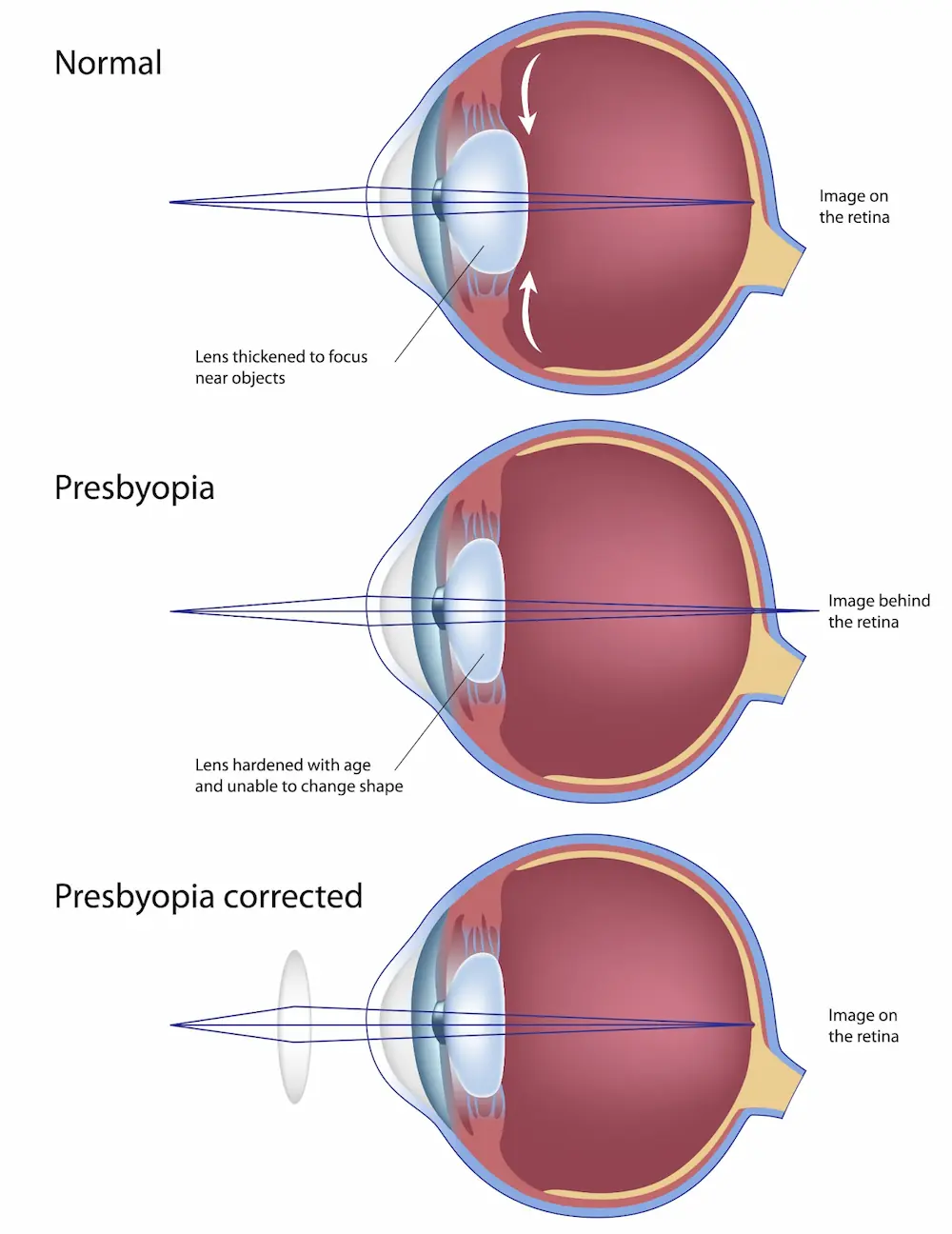
To understand why your vision is changing, we need to take a quick “biology break.” It is essential to distinguish between Hyperopia (traditional farsightedness caused by the eye being too short) and Presbyopia (age-related near vision loss). Your eyes aren’t “broken”; rather, the internal lens of your eye is naturally losing its flexibility.
When you were younger, this lens was soft and flexible, easily changing shape to focus on close-up objects—a process called accommodation. As you age, that lens stiffens and loses focusing power. LASIK fixes the surface (cornea), but Presbyopia is a lens problem. This is why standard LASIK alone often fails to fix reading vision. While LASIK can give you perfect distance vision, it doesn’t stop the internal lens from continuing to stiffen, meaning you’ll likely be back in reading glasses within a few years.
The 40+ Guide to Ditching Reading Glasses: LASIK, RLE, and What Actually Works
When you are searching for “vision correction near me” in Beverly Hills or LA, you’ll find several options. But which one is right for your “optical age”? Use this matrix to see how the leading procedures compare:
| Procedure | Best For… | Does it Fix Reading Vision? | Does it Prevent Cataracts? |
|---|---|---|---|
| Monovision LASIK | Patients comfortable with “blended” vision (one eye near, one far). | Yes (Temporarily) | No |
| Refractive Lens Exchange (RLE) | Patients 45+ who want a permanent, “one and done” fix. | Yes (Multifocal lenses) | Yes (Forever) |
| EVO ICL | Younger patients (under 40) with high prescriptions and/or thin corneas. | No | No |
| Vuity/Qlosi/Vizz Drops | Temporary relief for mild, early cases. | Yes (Temporarily) | No |
Understanding Your Options: Monovision vs. RLE
What is Monovision?
Monovision (or “blended vision”) LASIK is a technique where one eye is corrected for distance and the other for near vision. Your brain eventually learns to prioritize the clear image from the appropriate eye depending on what you are looking at.
“Is Monovision (one eye near, one eye far) going to drive me crazy?”
While many patients adapt beautifully, some find the “unbalanced” feeling or the slight loss of depth perception difficult to handle. At our Los Angeles practice, we don’t leave this to chance. Not sure if you can handle Monovision? We simulate it with contact lenses first. If your brain likes it, we can lock it in with LASIK. Keep in mind monovision LASIK is a work-around. It does not address the lens, which is losing focusing power. The lens will continue to focus less and will eventually become cloudy, the development of cataract. Fortunately, for those who want a permanent solution, allowing their eyes to work together seamlessly without compromise, there is a more advanced alternative.
What is Refractive Lens Exchange (RLE)?
If you are over 45 and looking for a permanent way to ditch reading glasses, you need to know about Refractive Lens Exchange (RLE).
RLE is a sophisticated procedure where the eye’s natural, stiffening lens is removed and replaced with an advanced, high-tech Intraocular Lens (IOL). This is the same proven technology used in modern cataract surgery, but it is performed electively to correct vision before cataracts even form. By replacing the lens that is causing the “trombone phase,” we can restore a full range of vision—near, intermediate, and far—without relying on the eye’s failing ability to focus.
Why RLE is Often Better Than LASIK After 45
If you search for vision correction options online, you will often see Monovision LASIK listed as the top choice for those over 40. However, as Dr. Rex Hamilton notes, this isn’t always the best move for patients in the 45-to-50-year-old range.
“I’ve been doing this for more than 20 years,” says Dr. Hamilton. “Monovision LASIK is not a permanent solution for needing reading glasses. In that age range, Refractive Lens Exchange (RLE) is a much better choice. With RLE, the two eyes work together, and it is a permanent solution. While many automated resources suggest monovision as the primary fix, they often miss the key clinical nuances for 45 to 50-year-olds who are struggling with reading glasses.”
The “One and Done” Argument
The most significant advantage of RLE is that it addresses the root cause of vision decline. Because the natural lens is replaced with a biocompatible medical implant, your prescription is “locked in” for life. No more “My eye doctor told me I need a new pair of glasses because my prescription is changing.”
“Will this prevent cataracts later?”
Yes. A cataract is simply the clouding of your natural lens that occurs as you get older. Because the natural lens is removed during RLE, you can never develop cataracts. By choosing RLE in your 40s or 50s, you are essentially pre-empting the need for cataract surgery later in life. You get to enjoy clear vision at all distances now, without the looming requirement of another surgery down the road.
Lifestyle Match: For the Active Angeleno
RLE is the perfect match for active people in Los Angeles. Whether you are a golfer trying to track a ball against the bright California sky, a knitter who needs precision at close range, or a professional who spends hours on a laptop in Beverly Hills, RLE provides a range of vision that LASIK simply cannot match for the 45+ demographic.
Addressing Your Top Questions (The Voice of the Patient)
“If I get LASIK now (at 45+), will it wear off in a few years?”
Standard LASIK does not stop the natural aging of your lens. You will still develop presbyopia and cataract, meaning you will eventually need reading glasses and your prescription will continue to change. This is why we often recommend RLE for patients over 45—it addresses the root cause of the problem rather than just the symptoms.
“Can’t I just get LASIK for reading glasses?”
Technically, we can perform “Monovision LASIK” to help with reading, but it is a compromise and not a permanent solution. It doesn’t fix the underlying lens stiffness; it just masks the symptoms by making one eye nearsighted.
“My friend got ‘Lens Replacement’ instead of LASIK—what is that?”
“Lens Replacement” is another name for Refractive Lens Exchange (RLE). It is the same sophisticated technology used in modern cataract surgery, but performed electively to eliminate the need for glasses before cataracts even form.
“Is it worth spending $5k+ if I’m just going to need glasses again in 10 years?”
This is the beauty of RLE. Unlike LASIK, which may require “enhancements” or be bypassed by further aging, RLE is permanent. The prescription of the implanted lens does not change, and because the natural lens is gone, your vision remains stable for the rest of your life. In the long run, RLE often saves patients money by eliminating the need for future cataract surgery and decades of expensive glasses and contacts.
What is the recovery time?
Recovery is rapid—most patients see better within 24 hours and return to normal activities almost immediately. While you may experience some mild scratchiness or “halos” around lights initially as your brain adjusts, most people are back to their routine in Los Angeles within a day or two.
Why Choose Hamilton Eye for Vision Correction in Los Angeles?
Stop guessing which procedure fits your eyes. At Hamilton Eye, we don’t just “sell LASIK”—we analyze your unique “Optical Age” to recommend the procedure that will give you the best lifestyle results for decades to come. Dr. Rex Hamilton is an internationally recognized leader in refractive surgery, bringing over two decades of expertise to every consultation in Beverly Hills.
Whether you are in Beverly Hills, West LA, or the greater Los Angeles area, we are dedicated to providing a personalized experience that prioritizes your long-term visual health.