

Presbyopia
If you’re finding yourself holding your phone at arm’s length to read a text, squinting at menus, or reaching for reading glasses more often than you’d like, you’re not alone. At Hamilton Eye Institute in Beverly Hills, Dr. Rex Hamilton offers patients throughout Los Angeles a personalized path forward, whether that means prescription drops, advanced laser vision correction, or lens replacement surgery.
As a board-certified ophthalmologist with more than two decades of experience, Dr. Hamilton evaluates every patient personally and recommends only what’s right for their eyes. Learn more about your options below, or schedule a consultation to find the right fit for your vision and lifestyle.


Presbyopia at a Glance
Presbyopia is the age-related loss of near focus that affects virtually every adult over 40. Whether you’re nearsighted, farsighted, or somewhere in between, Dr. Rex Hamilton offers a full spectrum of treatment options at Hamilton Eye Institute in Beverly Hills, including prescription eye drops, blended vision LASIK or EVO ICL, and refractive lens exchange, tailored to your vision, lifestyle, and goals.
- What Is Presbyopia?
- How Presbyopia Affects You Differently: Nearsighted vs. Farsighted
- Prescription Eye Drops for Presbyopia
- Surgical Treatments for Presbyopia
- Refractive Lens Exchange – The Gold Standard for Permanent Presbyopia Correction
- What to Expect at Your Consultation
- Why Choose Dr. Rex Hamilton
- Patient Stories
- Frequently Asked Questions
- Schedule Your Consultation
What Is Presbyopia
Presbyopia is the age-related loss of the eye’s ability to focus up close. Your eye focuses by changing the shape of its natural lens, a soft, flexible structure that thickens and curves in response to your ciliary muscle contracting. With age, the lens stiffens, not from disease or overuse, but from the same natural process that stiffens joints and grays hair over time. By your late 30s to mid-40s, depending on your prescription, that stiffening reaches a point where the lens can no longer change shape precisely enough to hold a clear image up close. That loss of near focus is presbyopia. You may also hear it called dysfunctional lens syndrome, a term that more precisely describes what’s happening inside the eye.
The condition typically worsens gradually until around age 60, when the lens is fully inflexible and near focusing has essentially stopped. Until recently, the only answers were external: reading glasses, bifocals, progressive lenses, and monovision contacts. These solutions work by borrowing optical power from outside the eye to make up for what the lens can no longer do on its own. For many patients, they remain a perfectly good choice. But they’re no longer the only option.
How Presbyopia Affects You Differently: Nearsighted vs. Farsighted
Your prescription before presbyopia sets in plays a big role in how and when you’ll notice it. Dr. Hamilton starts every presbyopia conversation with one question: are you nearsighted or farsighted? The answer changes what you’ll experience.
Farsighted (Hyperopic) | Nearsighted (Myopic) | |
Why symptoms appear earlier | Eyes already strain to focus at distance, leaving less accommodative reserve for near vision | Natural near focus can partially compensate for years |
Typical onset | Late 30s to early 40s | Mid-40s or later |
Early symptoms | Eye strain or fatigue after extended phone or computer use; over-the-counter reading glasses often help, sometimes for the first time ever | Near vision worsens while wearing contacts; the telltale sign is taking glasses off to read |
Best-suited treatments | RLE with trifocal IOL, blended vision LASIK, prescription drops | Blended vision LASIK or EVO ICL |
Glasses-free potential | Very high with surgical correction | High, with appropriate lens or laser strategy |
Farsighted patients generally notice presbyopia earlier than nearsighted patients, though exact timing depends on the degree of farsightedness. Understanding which group you fall into is one of the first things Dr. Hamilton sorts out during your consultation.
Prescription Eye Drops for Presbyopia
A new category of FDA-approved eye drops now offers a non-surgical, on-demand option for presbyopia. These drops work by gently constricting the pupil, which creates a pinhole effect that extends your range of focus, similar to how a smaller camera aperture sharpens depth of field in a photo.
Three options are currently available:
Drop | Active Ingredient | FDA Approved | When It Works Best | Duration |
Vuity® | Pilocarpine 1.25% | October 2021 | Mild-to-moderate presbyopia, once-daily use | ~4–6 hours |
Qlosi™ | Pilocarpine 0.4% | 2023 | Those sensitive to stronger pilocarpine, twice-daily | Up to ~8 hours |
VIZZ | Aceclidine 1.44% | July 2025 | Those seeking longest duration and minimal distance blur | Up to 10 hours |
Vuity was the first FDA-approved pharmacologic treatment for presbyopia in adults. In phase 3 clinical trials, approximately 30% of treated patients achieved a 3-line improvement in near visual acuity at three hours without meaningful loss of distance vision.
Qlosi uses a lower pilocarpine concentration designed to minimize side effects. In phase 3 trials, about 40% of patients achieved a 3-line improvement in near vision versus 19% with placebo, with a favorable safety profile and no serious adverse events.
VIZZ is the newest option and the only aceclidine-based drop on the market. In phase 3 trials, approximately 65-71% of patients achieved a 3-line improvement in near visual acuity at three hours, with effects lasting up to 10 hours. It is designed to minimize ciliary muscle stimulation, which may reduce the near-shift and headaches some patients experience with pilocarpine-based drops. VIZZ does create redness to the white part of the eye during the early phase of usage but this effect decreases over the first week or so of use.
Are drops right for you? They work best as a supplement to your existing vision correction or as a non-surgical option for patients who are not yet ready for surgery. They are not intended to replace glasses or contacts entirely, and results vary by individual. Dr. Hamilton will help you determine whether drops are appropriate based on your prescription, pupil size, and lifestyle.
Surgical Treatments for Presbyopia
If you’re looking for a more permanent solution, several surgical options can significantly reduce or eliminate your need for reading glasses and bifocals. Dr. Hamilton will recommend the right approach based on your age, prescription, corneal health, and whether preserving your natural lens or replacing it makes the most sense for your eyes.
Blended Vision
Blended vision is a surgical strategy that gives each eye a slightly different focal point, then lets your brain blend both inputs into a seamless range of sight, near, intermediate, and distance, without relying on glasses. Unlike traditional monovision, which sets a hard split between one distance eye and one near eye, blended vision uses a more nuanced correction that preserves binocularity and reduces the contrast imbalance that makes full monovision difficult for some patients.
Depending on your prescription and corneal anatomy, Dr. Hamilton may recommend one of several approaches to achieve blended vision:
Approach | How It Works | Best For |
Blended Vision LASIK | Reshapes the cornea differently in the two eyes with one eye more focussed on distance and the other focussed on near | Patients in their 40s–50s who are strong laser candidates and want to preserve their natural lens for as long as possible |
Flapless laser procedure; reshaping the two eyes differently as with LASIK | Patients with dry eye concerns or thinner corneas who want to preserve their natural lens for as long as possible | |
A lens added behind the iris without corneal reshaping; EVO ICL powers chosen differently in two eyes, one for distance and one for near | Patients with higher prescriptions outside the laser range, or those who prefer an additive, reversible approach |
Blended vision with a laser or additive lens is best suited to patients who still have a healthy natural lens and are not yet candidates for lens replacement. Dr. Hamilton will assess your corneal anatomy, prescription, and age to determine whether this approach is appropriate for your eyes.
Refractive lens exchange is the most comprehensive surgical solution for presbyopia. It involves removing the eye’s natural lens, the stiffened structure at the root of the problem, and replacing it with a premium intraocular lens (IOL) engineered to provide clear focus at near, intermediate, and distance simultaneously. Because RLE addresses the anatomical cause of presbyopia rather than compensating for it from outside the eye, it’s the closest thing to a permanent resolution available today. It also eliminates the future risk of cataract development, since the natural lens, where the cataract develops, has been removed.
RLE is typically the preferred approach for patients over 50, those with early cataracts, those with a prescription outside the ideal range for laser correction, or anyone whose priority is long-term freedom from glasses. As with any eye surgery, RLE carries risks, and not every patient is a candidate. Dr. Hamilton will review your eye health and determine candidacy during your consultation.
Dr. Hamilton offers several premium IOL categories, including the Light Adjustable Lens™, the only IOL that can be fine-tuned after surgery to optimize your vision before the prescription is permanently locked in:
IOL Type | How It Works | Best For |
Multifocal | Three distinct focal points: distance, intermediate, and near | Patients wanting the highest likelihood of complete glasses independence; halos around lights at night are present and take getting used |
Extended Depth of Focus (EDOF) | A continuous range of focus from distance through intermediate, functional near vision achieved through a blended vision approach | Patients prioritizing optical clarity and minimizing halos; to achieve three ranges of vision, a blended vision approach is utilized where lens power is chosen more for distance in one eye and more for near in the other |
Light Adjustable Lens (LAL) | A photosensitive lens that is implanted first, then precisely adjusted using UV light treatments in the weeks after surgery before being permanently locked in | Patients who want to fine-tune their outcome after surgery; to achieve three ranges of vision, a blended vision approach is utilized where lens power is chosen more for distance in one eye and more for near in the other |
The Light Adjustable Lens is particularly well suited to patients who want more control over their final visual outcome. After implantation, Dr. Hamilton uses a series of brief, non-invasive UV light treatments to sculpt the lens’s optical power to match your exact visual needs, then permanently locks in the prescription once you are satisfied with your vision. It is the only IOL that allows this level of post-operative customization.
Premium multifocal lenses offer remarkable results, by providing distance, intermediate and near vision in each eye. Multifocal IOLs have rings as part of their optical design which creates such a wide range of vision. The rings are associated with photic phenomena such as halos or starbursts around lights, especially at night. In addition, there is a slight decrease in contrast with these multifocal lenses, which some patients describe as a “waxiness” to the vision or like looking through a filter. During your consultation, Dr. Hamilton will set clear expectations and help you decide which lens category is the right fit for your lifestyle, occupation, and visual priorities.
What to Expect at Your Consultation
Your presbyopia consultation at Hamilton Eye Institute is a comprehensive evaluation, not a quick sales conversation. Dr. Hamilton and his team will:
- Review your vision history and current prescription
- Measure your corneal shape, thickness, and pupil size to determine candidacy for laser or lens-based options
- Discuss your lifestyle and priorities, including screen time, driving habits, reading needs, and activity level
- Walk through your treatment options in plain language using descriptive images, animations and simulations
- Answer every question you have and will never pressure you to make an on the spot decision
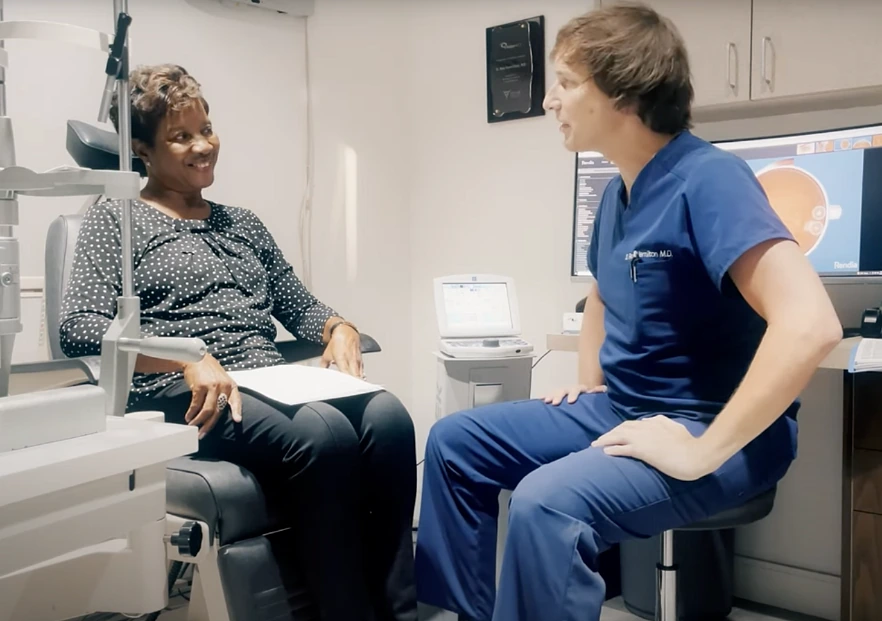

Why Choose Dr. Rex Hamilton
Dr. Rex Hamilton is a board-certified ophthalmologist with more than two decades of experience and over 25,000 procedures performed. He founded Hamilton Eye Institute in Beverly Hills with a single guiding principle: every patient deserves individualized, unhurried, expert care.
Dr. Hamilton trained and served on the faculty of the UCLA Stein Eye Institute, one of the nation’s top academic ophthalmology programs, where he served as Professor of Ophthalmology and Medical Director of the UCLA Laser Refractive Center for more than 15 years, training over 200 doctors from around the world. His background spans the full spectrum of refractive and lens-based surgery, making him uniquely qualified to offer both laser and surgical solutions for presbyopia, all under one roof.
Credentials and Affiliations:
- Board Certified, American Board of Ophthalmology
- Former Professor and Medical Director, UCLA Laser Refractive Center, Stein Eye Institute
- Fellow, American Academy of Ophthalmology (AAO)
- Fellow, American College of Surgeons (FACS)
- Charter Fellow, World College of Refractive Surgery and Visual Sciences (FWCRS)
- Member, American Society of Cataract and Refractive Surgery (ASCRS)
- First surgeon to perform SMILE on the West Coast
- Principal Investigator, multiple FDA clinical trials
- Ongoing Recognition: Castle Connolly Top Doctor, America’s Most Honored Doctors, Super Doctors Southern California
When you come to Hamilton Eye Institute, you’re consulting directly with Dr. Hamilton, not a technician or a physician’s assistant. He personally performs every evaluation and every procedure. For patients in Beverly Hills and throughout Los Angeles, that level of personal attention makes a meaningful difference.
Patient Stories
Hearing from patients who have been in your shoes is one of the most reliable ways to understand what presbyopia treatment is really like.
Frequently Asked Questions
Most people begin noticing presbyopia in their early to mid-40s, though symptoms can appear in the late 30s for those who are farsighted. The condition gradually worsens until around age 60, when the lens is fully inflexible and near focusing has essentially stopped.
Presbyopia can’t be reversed in the traditional sense, since it’s a natural aging process of the lens. However, it can be comprehensively corrected, with options ranging from prescription eye drops and glasses to surgical procedures that can free most patients from reading glasses entirely.
The FDA-approved drops available today, including Vuity, Qlosi, and VIZZ, have demonstrated favorable safety profiles in large-scale phase 3 clinical trials. The most common side effects include mild headache, eye redness, and temporary dim vision. Rare but serious complications have been reported with miotic drops in post-marketing surveillance, so it’s important to be evaluated by a physician before starting any drops. Dr. Hamilton will review your eye health history before recommending any pharmacologic option.
All three are FDA-approved drops that work by constricting the pupil to improve depth of focus. Vuity uses pilocarpine 1.25% (once daily, approximately 4 to 6 hours of effect). Qlosi uses pilocarpine 0.4%, a lower concentration that may cause fewer side effects (twice daily, up to approximately 8 hours). VIZZ uses aceclidine, a different active ingredient, and is the newest approval, offering up to 10 hours of near vision improvement with a mechanism designed to minimize blurring of distance vision.
It depends on the procedure and the IOL or laser strategy used. Patients who receive multifocal IOL implants through refractive lens exchange (RLE) achieve functional vision without glasses across all three ranges of vision in the majority of cases. If Dr. Hamilton recommends a strategy that provides three ranges of vision without glasses, he will stress explain: “Near means cellphone level vision, not small print on package inserts. Small print will likely require over the counter readers. Intermediate means desktop computer and grocery store shelf. You may find there is a sweet spot distance for the desktop computer that differs from what you have been used to.” Blended vision strategies using LASIK, SMILE, EVO ICL and RLE with EDOF IOLs significantly reduce reading glass dependence. During your consultation, Dr. Hamilton will give you a realistic picture of what to expect based on your eyes and your goals.
Standard vision insurance and Medicare typically cover medically necessary cataract surgery with implantation of a basic (monofocal: 1 range of vision) lens but don’t cover refractive lens exchange for presbyopia alone or laser vision correction. Prescription eye drops may be covered depending on your plan. Our team will help you explore your coverage and financing options during the consultation process.
In many cases, yes. Studies have confirmed that pilocarpine drops can be effective in patients with a history of LASIK or PRK. However, compatibility with your specific lens type and prescription should always be reviewed by your physician. Dr. Hamilton will assess your individual situation before making any recommendations.
Not everyone is a surgical candidate, and that’s completely acceptable. Prescription drops, monovision contact lenses, and progressive spectacle lenses are all valid, effective options for presbyopia management. Dr. Hamilton’s goal is always to find the right solution for you, not to recommend surgery when it isn’t the right fit.
Source Index
- Cleveland Clinic. Presbyopia. https://my.clevelandclinic.org/health/diseases/8577-presbyopia.
- Turbert D. Presbyopia. StatPearls, NCBI Bookshelf NBK560568.https://www.ncbi.nlm.nih.gov/books/NBK560568/
- Moshirfar M et al. Safety and Efficacy of AGN-190584 (GEMINI 1). JAMA Ophthalmol.https://pubmed.ncbi.nlm.nih.gov/35238902/
- Walters T et al. Efficacy and Safety of CSF-1 (NEAR trials).https://pubmed.ncbi.nlm.nih.gov/38216351/
- FDA VIZZ Prescribing Information, NDA 218585.https://www.accessdata.fda.gov/drugsatfda_docs/label/2025/218585s000lbl.pdf
- Hatch KM et al. Visual Outcomes After Bilateral RLE With Trifocal IOL. PMC10164213.https://pmc.ncbi.nlm.nih.gov/articles/PMC10164213/
- Hayashi K et al. Difference in Quality of Vision: EDOF vs. Bifocal vs. Monofocal IOL. PMC9223205.https://pmc.ncbi.nlm.nih.gov/articles/PMC9223205/